
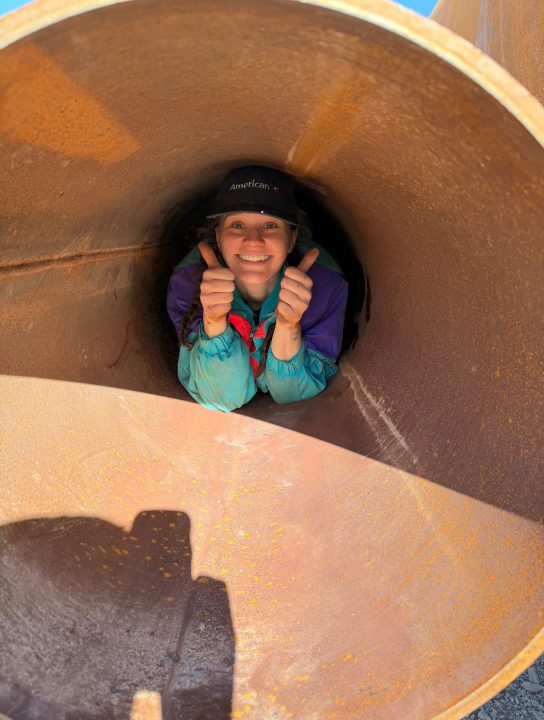
A comment meant to discourage Anna Amato became the spark that ignited her determination to pursue nondestructive testing and excel in a male-dominated field.
As a high school senior, Anna first heard about NDT during a classroom presentation led by a university professor. Magnetic particle theory fired her imagination, but when she reached out to the professor, he told her that NDT was a difficult career for a woman and she’d be better off in a different pursuit.
Not so fast, Anna thought. Her search for schools that offered certification in NDT led her to TCC’s Nondestructive Inspection, Testing & Evaluation program, a nearby and affordable option. To her surprise and encouragement, a woman led the program — and still does.
“Since the very beginning, Anna stood out for her focus, work ethic and commitment to excellence in NDT,” Professor Venicia Queen said. “She didn’t just complete assignments — she pursued mastery. She challenged me as an instructor to continually elevate the rigor of my projects because she was always ready for more.
“Watching her growth in technical skill and confidence was incredibly rewarding. As a woman in this field, she did not only succeed but inspired many others by her presence and performance.”
In May 2025 Anna made history as the first woman to graduate from TCC’s NDTE program. Today she’s building on that achievement by working as a full-time industrial radiographer.
This interview has been edited for length and clarity.
Describe your time at Tarrant County College.
I started in the fall of 2023 after graduating from high school earlier that year. In my first semester I fell in love with ultrasonics; the theory behind the method captivated me. I remember being very excited to finish my radiation safety class so I could use the X-ray cabinet on campus. Today, radiography and ultrasound are my favorite methods in NDT.
Can you remember the first time you held an ultrasonic probe or looked at a radiograph?
The first time I set up an ultrasound machine, I wasn’t confident that I knew what I was doing, but as it turned out, I had perfectly calibrated it.
What does a typical day in your job look like?
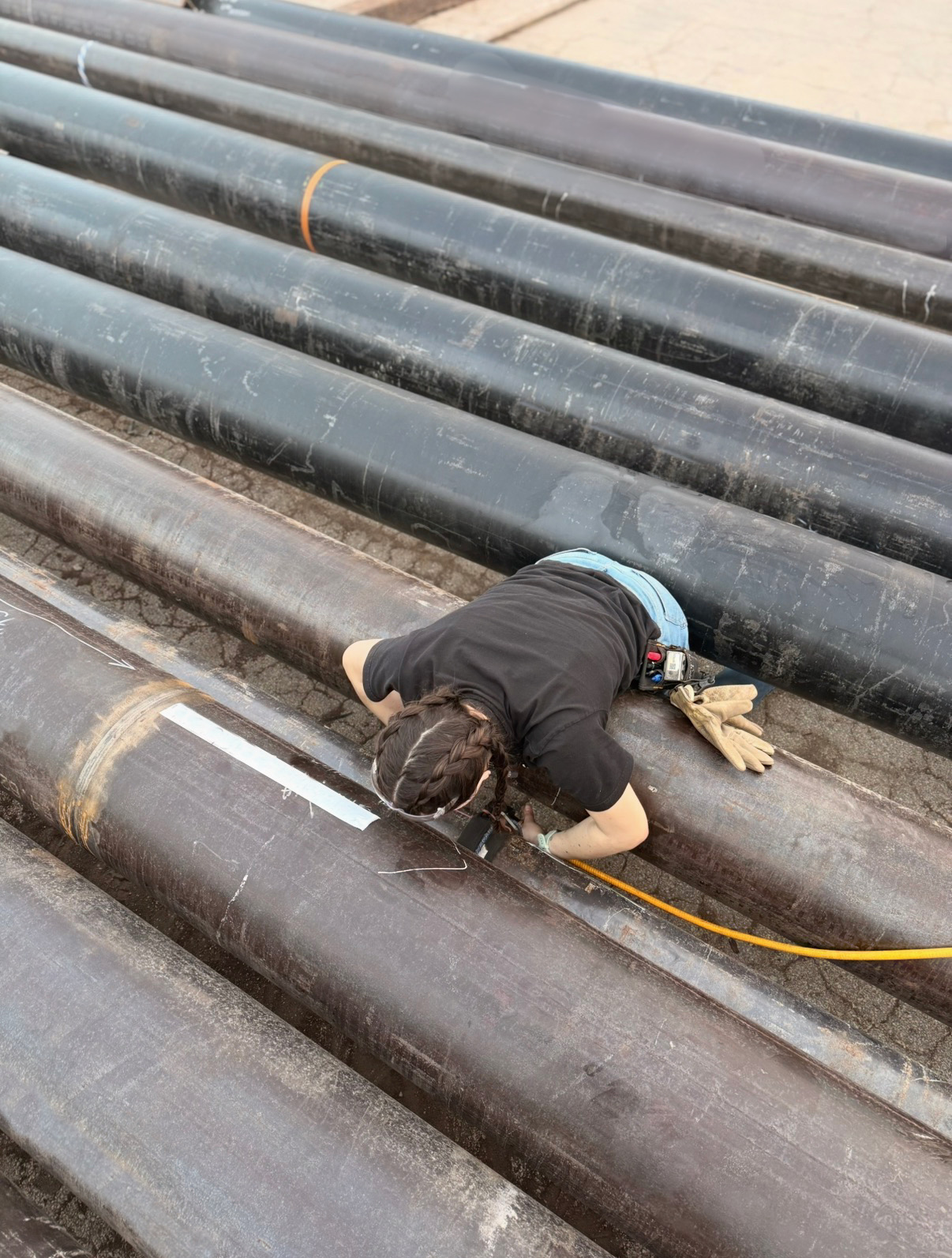
A typical day consists of performing safety checks, radiographing and inspecting a minimum of 25 pipe welds, and of ensuring the safety of non-radiographers who work alongside me.
Have you ever found something during an inspection that changed a project or even saved lives?
One time, I noticed an electrician doing maintenance on one of the overhead cranes by the cells where we perform radiographic inspections. I told my supervisor, and all the radiographers had to stop working and wait until he left. Nobody had said someone would be working overhead, and he wasn’t aware that he would have been exposed to high radiation. If I hadn’t been extra observant that day, that man might’ve fallen very ill.
Do you ever think about the people who rely on the things you inspect — planes, bridges, pipelines? How does that responsibility weigh on you?
I work for a pipe manufacturing company that sells to various customers, so I never know what the pipes will be used for. I find it entertaining to make educated guesses about each pipe’s usage based on the size, geometry and material of various parts. I take pride in the integrity I have for ensuring that I inspect each part to its applicable code; there’s no telling what the parts are used for, so quality must be upheld for safety reasons.
What does this line of work mean to you?
My journey through the world of NDT has meant a lot in terms of self-efficacy and self-actualization. It has helped me be more confident in my ability to succeed because there are clear paths to follow with defined points. Nondestructive testing as a career motivates me because there’s always a new goal to achieve and new heights to reach.
What’s a sound, smell or sight that instantly tells you something’s wrong?
I know there’s something wrong when I hear my rate alarm. A rate alarm is a device that radiographers wear on their bodies to detect radiation levels that exceed a certain threshold. It’s super important because radiation is not a thing to be trifled with.
What advice would you give prospective students considering a career in NDT?
Just go for it. There’s a growing demand for NDT professionals across a wide range of industries, including aerospace, automotive, oil and gas pipelines, batteries, electronics and infrastructure. It’s a versatile field that can open doors and give you a strong entry point into nearly any industry.