
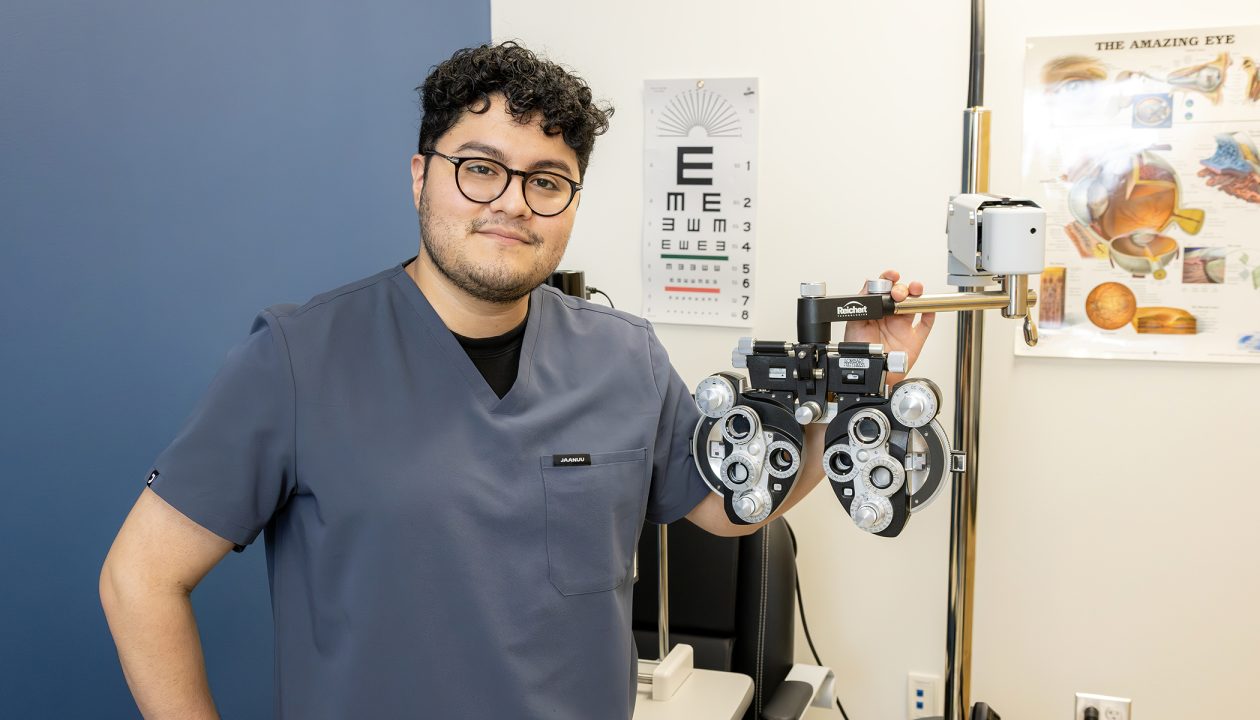
“At first, I wanted to quit.”
Jesus Vazquez says it without embarrassment. He was new to the optical field, overwhelmed by the science, unsure he belonged anywhere near a patient. He had come from accounting courses and food service shifts, and nothing about that background had prepared him for the precision and patience the optical job demanded. Quitting would have made sense.
But he stayed. Then he stayed three more years.
Quiet and undramatic as it was, that stubbornness proved to be the defining move of his professional life. Today Vazquez is a first-year student in Tarrant County College’s Ophthalmic Technician program, bringing with him something most of his classmates are still working toward: the hard-won certainty that this is exactly where he’s supposed to be.
The path that led him to TCC was anything but direct. He had been studying accounting and working in food service when a friend connected him with Visionworks, a local optical store offering on-the-job training. Vazquez had always wanted to work in medicine but had never found a way in. This was an open door, and he walked through it.
The early days were tough.
“It was completely overwhelming, to the point where I almost quit,” he recalls. “But I pushed through, and eventually something clicked.”
What clicked, it turned out, was the patient. Vazquez found that explaining a difficult concept to people who were confused or frightened about their vision and then watching them leave the office relieved and informed gave him a satisfaction he hadn’t found anywhere else. “That feeling told me there was so much more to learn,” he says.
“At the end of the day, the two things that matter most to me are learning and helping people. This career delivers both.”
After three years in the field, he enrolled at TCC to formalize what he had been absorbing on the job. The Ophthalmic Technician program gave his experience a structure. In clinical terms, he describes the role the way any good technician might: concise and patient-first.
“We’re like the nurses in the optometrist’s or ophthalmologist’s office. We prepare the patient before they ever see the doctor — gathering their chief complaint, taking their history, verifying insurance, testing their vision. We’re the first clinical contact, and we set the tone for the entire visit.”
You sense that Vazquez imagines eye care in terms that far exceed intake forms and visual acuity charts.
“People say the eyes are the windows to the soul. Studying in this program has made me realize just how true that is, medically speaking.” The eyes, he has come to understand, are not isolated organs. They change with age, respond to illness, and bear the marks of injury. More importantly, they often reveal systemic conditions before any other body part does.
“The eyes can reveal a lot about what’s happening in the rest of the body,” he says. “You’re learning medicine, not just ophthalmology.”
That depth showed up immediately in the classroom. The program’s first course, Anatomy of the Eyeball, left an impression.
“It genuinely opened my eyes,” Vazquez says, smiling at the phrasing. “I had no idea how complex this seemingly simple organ actually is. You take it for granted every single day, and then you start learning the structures, the layers, the interconnected systems, and it’s remarkable.”
He is equally eager about an upcoming course on contact lenses, a subject with personal resonance.
“I’ve worn contacts for years. I’m excited to actually understand how they function, how they interact with the eye’s surface, and what makes one type better suited than another for a given patient. That’s the kind of knowledge that will make me a better technician.”
Much of what makes the program work, Vazquez says, comes down to the instructors — not just what they know, but how they teach.
“Every class is engaging, but what stays with you is their passion. They don’t just explain a concept — they show you why it matters to the patient sitting in front of you. You never feel embarrassed for asking a question. That kind of environment makes you want to learn more.”
It is the difference between acquiring information and actually becoming a clinician.
Asked what happens next, Vazquez responds with confidence. Completing the program remains his immediate priority, but he’s open to pursuing optometry should the opportunity arise. If it does not, he is equally committed to advancing within the field through certifications and continuing education.
“This field doesn’t stand still,” he says, “and neither do I.”
For students considering the program, Vazquez offers both a warning and an invitation. The work is demanding, the knowledge base is deep, and every concept builds on the last. There is no coasting. But for the right person, there is also no ceiling.
“If you love to learn, if you love helping people, and if you want to do work that makes a difference every single day,” he says, “this is the program for you.”