
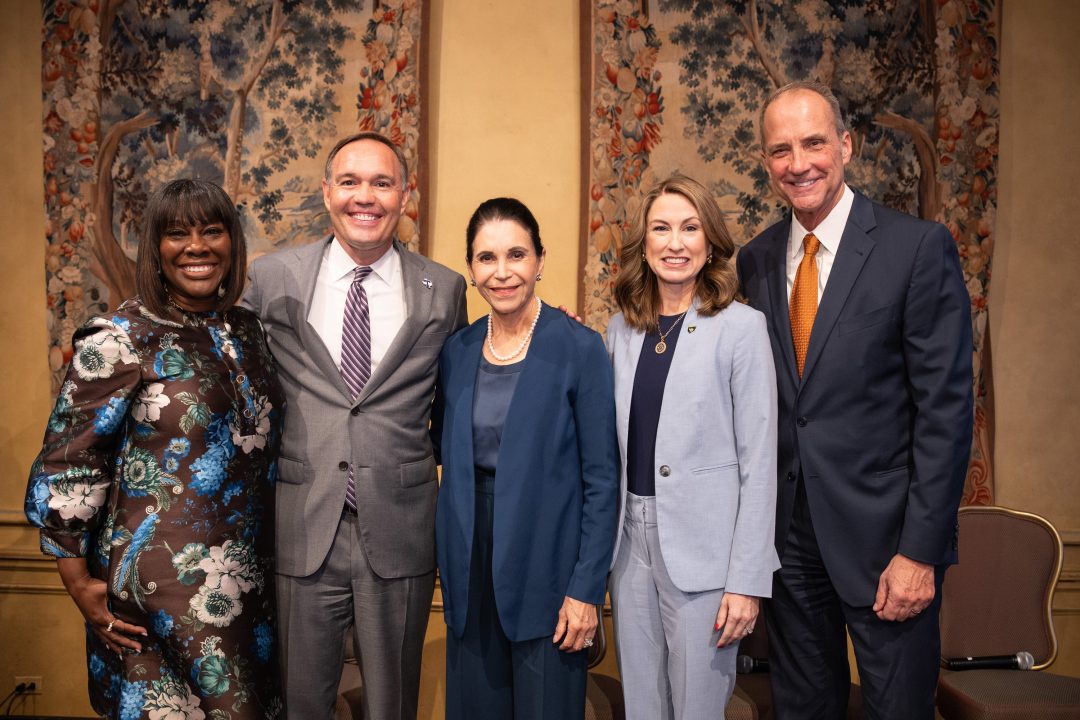
FORT WORTH, Texas — Before most of downtown had finished its first cup of coffee, the ballroom at The Fort Worth Club was already buzzing. Education, business and civic leaders gathered over breakfast Tuesday for the Fort Worth Business Press 2026 State of Higher Education Forum, and the conversation kept returning to one idea:
The region’s future is being built at the intersection of education and industry, and no one builds it alone.
Texas A&M-Fort Worth Chief Operating Officer Robert Ahdieh said Fort Worth and Tarrant County’s higher education institutions stand apart — rather than asking what the community can do for them, they constantly ask what they can do for the community, whether it’s meeting workforce training needs, strengthening the student-to-employee pipeline or building research collaborations.
Together, he said, that work has the potential to help the city, county and region grow in ways no one can yet imagine.
Tarrant County College Chancellor Elva LeBlanc put community colleges at the front door of that work, often the first place students and employers meet. Each institution has its own mission, she said, and strong communication between industry and higher education, along with curriculum aligned to employer needs, is critical to the region’s success.
Dr. LeBlanc pointed to TCC’s work with aviation, automotive and healthcare industries as examples of what happens when colleges and employers design pathways together: Students don’t just earn credentials. They move into careers waiting for them. That kind of alignment also keeps talent at home.
“I’m proud to say 85 percent of Tarrant County College graduates stay in Tarrant County,” she said. “Without an educated workforce, it’s very hard to recruit companies to the region.”
Keeping that talent at home concerns Tarleton State University President James Hurley. Speaking for a university whose footprint stretches from its Stephenville origin campus to a growing presence in Fort Worth, Dr. Hurley made the case for greater unification to counter “brain drain.”
North Texas, he said, is one of the most heavily recruited regions in the state, with out-of-state institutions aggressively pursuing its highest-achieving students.
“They’re not coming after the 25 through 50 percent. They’re coming after the students in the top 5 to 10 percent,” he said. “When we lose students to an out-of-state institution, it’s much harder for us to attract them back to our state, in particular, back to our region.”
Texas Wesleyan University President Emily Messer offered an answer: build those connections early and close to home. Scale isn’t the only measure of impact, she argued; the university’s ties to its East Fort Worth neighborhood and local school districts allow it to move quickly when community needs shift.
One example is a School of Education partnership with the Everman ISD that lets students in the CTE education pathway earn 12 credits through junior- and senior-level courses.
“They’re getting a head start on becoming teachers,” Dr. Messer said. “We all should be focused on increasing the teacher pipeline.”
Building pipelines is the daily work of Fort Worth Chamber of Commerce President and CEO Steve Montgomery, who closed the loop from industry’s side of the table. He described the Chamber’s role as “curating introductions,” drawing on daily conversations with owner-operators, midsize companies and target employers such as American Airlines, Lockheed Martin, Bell, BNSF and Alcon.
When asked about their challenges, he said, those employers cite everything from regulation to the cost of capital to market conditions, but one concern consistently dominates. “Invariably, number one or two on the list is attracting and retaining a workforce with the skills their industry needs.”
Internships, externships and public-private partnerships are essential to that workforce retention, the panel agreed. They also give students a chance to prove what they can do — and employers a chance to find the talent they need.
Representatives from American Airlines, Autobahn Fort Worth and the Fort Worth Police Department shared examples of those opportunities leading to full-time careers.
Jess Barrier, managing director of Maintenance Operations Control and Training at American Airlines, knows that potential firsthand. He began his own career at American as an intern 27 years ago. His story brought the larger point into focus:
Education is most powerful when it leads somewhere — and when colleges, universities, public schools and employers work together to create those pathways.
Tarrant County College serves nearly 100,000 students each year, offering accessible, affordable pathways to in-demand careers and university transfer. Across multiple campuses and TCC Connect — a fully online learning option — the College partners with more than 1,200 employers to help build the workforce that drives North Texas forward. Bold Steps. Better Futures.